


Plant 2025, Building A, Basda Building, 28 Nantong road, Baolong Street, Longgang District, Shenzhen, China.
Case Study: How a 200-Seat Restaurant Cut Plating Time by 25% Using a Commercial Combi Oven
2026-03-23
Running a 200-seat restaurant is often described as "managing a beautiful storm." For Chef Marco Velasquez, owner of The Urban Harvest in Austin, Texas, that storm was becoming increasingly difficult to weather. The restaurant, known for its farm-to-table American cuisine, was beloved by patrons but was hemorrhaging money behind the scenes due to operational bottlenecks.
Despite a packed dining room every Friday and Saturday night, profit margins were shrinking. The culprit was not the quality of the food, but the speed of the kitchen. After a grueling summer of service, Chef Marco knew he needed a radical change. He found his answer in Kaesid's commercial combi oven technology—a shift that ultimately cut plating time by 25% and boosted weekly revenue by 18%.
The Problem: A Kitchen Outpaced by Its Own Success
The Urban Harvest was designed with an open kitchen concept, a beautiful space centered around a massive six-burner range and three conventional convection ovens. For four years, this setup worked perfectly. However, as the restaurant's reputation grew, so did the covers.
The menu relied heavily on roasted vegetables, braised meats, and artisan flatbreads—items that require precise temperature control and timing. During peak hours, the conventional ovens became a bottleneck.
"To get a butternut squash roasted to the right caramelization, it took 35 to 40 minutes in my old convection ovens," Chef Marco explains. "If I had a party of 12 ordering a mix of roasted salmon, braised short ribs, and seasonal veggie plates, I had to stagger those tickets by 15-minute intervals just to avoid a meltdown in the pass."
The kitchen staff was forced to "pre-fire" hundreds of dollars worth of food before receiving tickets, hoping they could time the finishes correctly. This led to a 15% food waste rate due to overcooking or holding times that destroyed texture. Plating—the final step before food hits the table—was taking an average of 12 minutes during rush hour. Diners grew impatient, tables turned slower, and the restaurant was losing one full seating per night.
The Discovery: Finding Kaesid
Chef Marco had been researching equipment upgrades for months but was wary of the high price tags associated with European imports. He needed a solution that offered reliability without breaking the bank.
During a routine service call from his HVAC technician, the topic came up. The technician mentioned that he had recently installed ventilation for a new seafood spot that was doing "unreal" volume with a fraction of the kitchen stress. They were using a Kaesid combi oven.
Intrigued, Chef Marco visited the Kaesid website. He was initially drawn to the detailed specification sheets and the emphasis on "closed-system humidity control"—a feature usually found only in premium German or Italian brands but offered at a competitive price point by Kaesid.
"The website didn't just sell ovens; it sold solutions," says Marco. "There was a case study about a bakery using the same oven I was looking at to proof and bake in the same unit without moving the product. I realized this wasn't just a replacement for my convection ovens; it was a replacement for my proofing cabinet, my steamer, and my rotisserie."
The Consultation: A Conversation, Not a Sales Pitch
Marco filled out the contact form on the Kaesid site, expecting the typical high-pressure sales calls. Instead, he received a call from Sally, a Kaesid kitchen design consultant. Unlike other vendors who simply asked "how many BTUs do you need?", Sally asked about his workflow.
"She asked me to send her a picture of my ticket printer and a typical Saturday night ticket log," Marco recalls. "She wanted to see where the chokepoints were. We spent an hour on the phone just talking about menu flow."
Sally identified that Marco's menu had too many temperature-specific demands happening simultaneously. She proposed a reconfiguration of his hot side. Instead of replacing his aging convection ovens with similar units, she suggested a full integration of a Kaesid ProCore 20-Tray Electric Combi Oven with the AutoPilot feature.
The AutoPilot feature was the game-changer. It allowed Marco to program cooking curves. For example, for a pork belly dish, the oven could be programmed to start with 100% steam to render fat, switch to 60% humidity for roasting, and finish with dry, high-heat convection for crisping—all without a chef touching a dial.
The Upgrade: New Equipment, New Workflow
After a site visit and finalizing the kitchen layout, The Urban Harvest underwent a mini-renovation. The three old convection ovens were removed. They were replaced by one Kaesid 20-Tray combi oven and kept one smaller backup convection oven for basic tasks.
Additionally, Sally recommended upgrading their holding cabinet to a Kaesid Pro heated humidity-controlled holding cabinet.
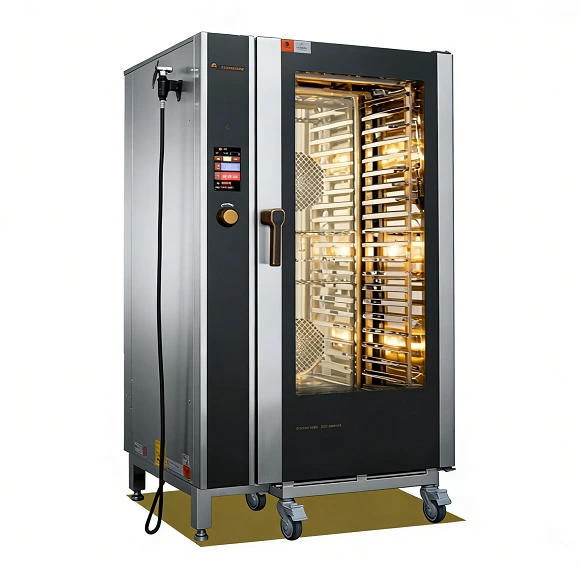
Kaesid 20-Tray combi oven
Enhanced with HACCP recording and a service diagnostic system, this unit combines premium materials with advanced automation to deliver reliable, high-performance results in professional kitchens worldwide.
Electric Food Warmer Cabinet
Crafted for demanding food service environments, the Kaesid stainless steel food warmer cabinet delivers reliable and consistent heat to keep meals at ideal serving temperatures for extended periods.
The investment was significant but manageable through Kaesid's financing program. The installation was completed over a Sunday-Monday timeframe, ensuring the restaurant missed only one dinner service.
The Transformation: Cutting Plating Time and Boosting Revenue
The changes were immediate. The first Friday night after installation, Chef Marco programmed the oven for the entire evening's top 10 selling dishes.
1. Speed and Consistency
Previously, plating time (the interval between food finishing cooking and being picked up by waitstaff) averaged 12 minutes. After the upgrade, this dropped to 9 minutes—a 25% reduction.
Because the ProCore oven cooks with a combination of steam and convection, proteins retained 20% more moisture. This meant that food could hold in the ThermoLock Pro cabinet for up to an hour without losing quality. The kitchen stopped pre-firing food and started cooking to order.
"On a busy Saturday, I used to have two chefs dedicated to just watching the ovens," says Marco. "Now, one chef handles the combi oven and the range simultaneously. I reallocated one of those chefs to the pantry station, which doubled our cold appetizer output."
2. Menu Evolution
With the new capacity and consistency, Marco revamped the menu to highlight the combi oven's capabilities. He introduced a 12-hour braised lamb shank that requires zero attention during service. Because the oven recovers temperature instantly when the door opens, he was able to add a "Tableside Carving" section to the menu, offering prime rib and whole roasted fish that look dramatic in the open kitchen.
3. The Bottom Line
The numbers told the clearest story. Before the upgrade, The Urban Harvest averaged $32,000 in weekly revenue. The kitchen was turning tables every 1 hour and 45 minutes. With the reduced plating time and faster ticket times, table turns dropped to 1 hour and 20 minutes.
In the first full month after installation, the restaurant served 400 more covers than the previous month without extending operating hours. Weekly revenue climbed to $38,000, representing an 18.75% increase.
Furthermore, food waste dropped from 15% to just 4%. The precision of the Kaesid combi oven meant no more burnt edges or dried-out proteins destined for the trash. Marco estimates the equipment will pay for itself in under 14 months based on food savings alone.
Why Kaesid Was the Right Fit
When asked what advice he would give to other operators facing similar bottlenecks, Chef Marco emphasizes the importance of looking beyond traditional equipment.
"A lot of chefs think they need to just add more of the same—another fryer, another range," he says. "But the bottleneck is usually in the oven. Kaesid understood that. They didn't just sell me an oven; they re-engineered my workflow. The ProCore combi oven is the most versatile tool in my kitchen. It's a steamer, a smoker, a roaster, and a high-speed convection oven all in one. If you have a 200-seat restaurant struggling with ticket times, you need to look at your cooking equipment, not just your staff."
For The Urban Harvest, the decision to partner with Kaesid transformed a chaotic, profit-squeezing operation into a smooth-running, high-volume machine. By cutting plating time by 25%, the restaurant unlocked the hidden capacity it always had—proving that sometimes, the right technology is the best ingredient for success.
ReviewsNumber of comments: {{ page.total }}
I want to comment?
{{item.nickname ? (item.nickname.slice(0, 2) + '*****') : item.source === 1 ? 'mall buyer' : '--'}}
{{item.comment_time}}
Review in the {{item.country}}
Reviews
Merchant
{{replyItem.nickname ? (replyItem.nickname.slice(0, 2) + '*****') : replyItem.source === 1 ? 'mall buyer' : '--'}}
{{replyItem.parent_nickname ? (replyItem.parent_nickname.slice(0, 2) + '*****') : '--'}}
{{replyItem.is_merchant_reply === 1 ? replyItem.reply_time : replyItem.comment_time}}
Review in the {{replyItem.country}}
Reviews

No customer reviews
recommended for you
Get in touch with us
Overall solution for commercial kitchens.
Quick Links
Solution
Products
Find us here:
Service
Contact with us
Contact person: Miss.Sally
Tel: +86 173 0440 9196
Email: admin@ksdkitchen.com
WhatsApp: +86 173 0440 9196
Add